
ENTER YOUR EMAIL TO RECEIVE OUR WEEKLY NEWSLETTER
Fun and Games with Sergeant Ruiz
Ruthless and relentless basic training at Fort Gordon, Georgia in 1966
. . . . . . . . . . . . .
My Vietnam War, 1966–1968, Article No. 4 in a Series
. . . . . . . . . . . . .
On a blazing day in June, 1966, I stood with a bunch of sweaty, anxious fellow draftees in front of our fort—a large, warehouse-like building in Fort Gordon, Georgia.
A cluster of prefabricated barracks, forlorn assembly grounds, and faceless administration buildings, the fort sat glumly on the red-baked earth. A few stands of pine trees and patches of sun-parched grass tried their best to survive the savage heat.
And I, a fervent New Yorker, was trapped in an alien landscape.
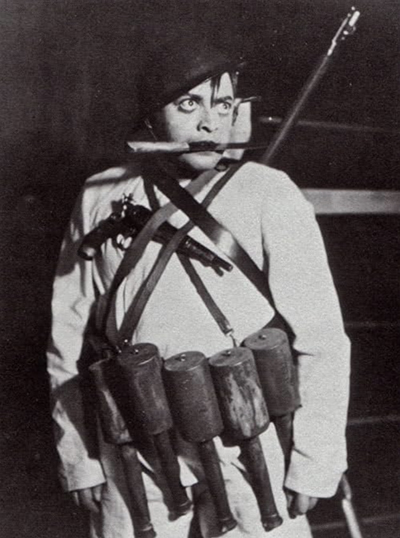 . . . . . . . . . . . . .
A civilian (Peter Lorre) is press-ganged into a machine-gunner’s squadron and transformed into the perfect soldier in Bertolt Brecht’s A Man’s a Man (1931).
. . . . . . . . . . . . .
I remembered Bertolt Brecht’s play A Man’s a Man, which was also set in a training camp. There the British colonial army transformed Galy Gay, a mild-mannered peddler, into a savage, brutal killer—which struck me as ominously relevant. Would I wind up similarly overhauled?
That wasn’t an idle question. I was a Harvard-educated hothouse flower, a servant of the arts—and little else. I was resolutely unathletic—no, anti-athletic—which meant I wasn’t especially fit or buff. Yes, I’d once spent a few months working out in a decrepit Manhattan gym, but quickly gave it up as boring and unproductive. To make matters worse, I was totally opposed to our war in Vietnam.
Shortly before I reported for duty, my mother had assured me I’d never be sent to Vietnam. She’d run into a friend at a Manhattan cocktail party who promised that her husband, a retired Army general, would put in a good word for me with Fort Gordon’s commanding officer. I explained to Mom that things didn’t work that way. And I knew from Brecht’s play that the Army followed its own imperatives.
Certainly we had no say about what happened to us on our first day at Fort Gordon. A pair of sergeants suddenly rushed out of the building, bellowing like elephants, and herded us inside. Much to our surprise, that building wasn’t a warehouse. It was the camp barbershop, its floor thick with the shorn hair of other recruits. A gathering of civilian barbers stood by their chairs, shavers at the ready, eyeing us with icy amusement. Our Samson moment had arrived.
The room felt funereal. The only sound was the dull, steady buzz of shavers. No matter how thick or abundant our hair, no matter how chic its styling, it took only a few minutes for the barbers to reduce it to a regulation Army buzz cut.
Freshly shorn, freshly humbled, we were jogged by the sergeants to our next destination—the quartermasters’ unit. There, with amazing rapidity, the staff sized us up and tossed us the uniforms and gear that would rule our lives for the next few years. We stuffed the paraphernalia into a duffel bag, slung it over our shoulders, and clustered at the rear of the room, awaiting the next command.
Suddenly a voice boomed out: “All those with passports, front and center!” I’d been dreading that moment. My draft board had informed me that all draftees must surrender their passports at the start of training. I treasured mine with an almost religious fervor; it had opened up the world to me. While most of the other guys stayed put, I walked forward and handed over the cherished document. My vague thoughts of rushing off to Canada or Sweden, havens for draft resisters, evaporated. I was U.S. Army property for as long as it chose to keep me.
The sergeants started barking again. They ordered us to collect our gear, sling it over our shoulders, and follow them to our barracks. Once outside, they launched into another jog, much faster than before. We struggled to keep up, our duffels pounding our backs.
We were breathing hard by the time we reached the barracks. Ours was just like all the others: a two-story barnlike structure with cream-colored wood siding. The sergeants kept us standing at attention in the blazing Georgia sun while they went inside.
They returned soon enough with a new pair of sergeants. The younger one—a tall, alarmingly well-built Puerto Rican—wore a uniform starched so heavily that his trousers had knifelike creases. His considerably shorter partner, a grizzled white guy with six stripes on his sleeve to the Latino’s journeyman five, took a more relaxed approach to military attire. His uniform looked as rumpled and ill-fitting as ours.
“Listen up, guys,” said the lead jogger. “Sergeant Ruiz and Sergeant Reilly here are your drill instructors. They’ll be with you night and day for the next eight weeks. Their word is God, and don’t you fucking forget it.”
They saluted and left, no doubt pleased to be rid of us.
Once they’d gone, Sergeant Ruiz stepped forward and took a good, hard look at his new charges. He didn’t like what he saw.
“You trainees come here, you sleep in my barracks, they’ one thing sure. Yo’ ass belong to me. No mommy and daddy here. You my property now, my!” he said, pounding his chest for emphasis. “That mean no fucking around. You do what I say, no trouble. You give me the ass? I give it right back. Big time.…Clear?” We stared at him, fascinated. “Clear?”
“Yes, sir!” we replied.
Sergeant Reilly finally spoke up, his tone collegial. “It’s ‘Yes, sergeant,’ men. Sergeant Ruiz isn’t a commissioned officer; you don’t call him sir.”
“You got that, soldiers?” asked Ruiz, still at full volume.
Most of us said, “Yes, sergeant” as required, but a few jokers brayed, “Yes, sir!” and guffawed.
Sergeant Ruiz froze. “Who said that?”
Our group went silent.
“Who fucking said that?”
The silence held.
His body stiff with rage, Ruiz strode through our ranks, hunting down the perpetrators. He finally found the three of them, still smirking, in the very last row. “What’s so fucking funny?” he thundered.
The jokers faced straight ahead, their faces blank.
“What I tell you if you give me the ass?” He loomed over them. He was taller and far better built than they were. He pointed imperiously at the floor. “Get down and give me ten.”
The men looked at him in bewilderment. “You heard me, assholes— ten big ones, now!”
Sergeant Reilly stepped in to explain. “Those snickers cost you ten push-ups, men. Hit the ground—now!”
The two tossed their duffels aside and huffed and puffed their way through ten approximations of a push-up.
Once they stumbled back in line, Ruiz reprised his great theme: “As long as you here, yo’ ass belong to me. Do what I say and don’t give me no ass. Clear?”
All of us, even the jokers, shouted, “Yes, sergeant.”
We were subdued that first night in the barracks. Beat from the jogging, spooked by our haircuts, infuriated by Ruiz, all we wanted was sleep.
We didn’t sleep long. The next morning—probably around 7:00, but it felt much earlier—Ruiz was back in action, pounding on the metal posts of our bunk beds like a berserk percussionist.
“Up, up!” he howled. “Off yo’ ass and on your feet! Now!”
We had staggered to the lavatory to splash water on our bleary eyes when Ruiz reappeared. “No time for that! Formation in five minutes! Get yo’ ass outside!”
And so we began basic training—the U.S. Army’s whirlwind introduction to the martial “arts,” including military drill (right face, left face, about face, HALT!), military protocol (brace and salute all officers), military attire (pants and shirts starched at all times, belt buckles polished till they gleam, hair trimmed to regulation length—quarter inch), riflery (brandish your rifle and say, “This is my weapon”—point to your crotch—“This is my gun; one is for fighting, the other for fun.” Ha-ha…), housekeeping (make your bed with tight military corners; keep toilets and washbasins spic-and-span; organize your footlocker obsessively), self-defense (kick the guy in the balls).
Over time, training at Fort Gordon felt more like an operetta than a Brecht horror show, with one big exception: Sergeant Ruiz. He kept up the pressure relentlessly, mocked us, hounded us, scolded us. Everyone in the company hated him.
Fortunately, he was rarely around on weekends. Left on our own, freed from his hectoring, we read, snoozed, listened to radio, wrote letters, and gossiped about our (real or imagined) sex lives. It felt great.
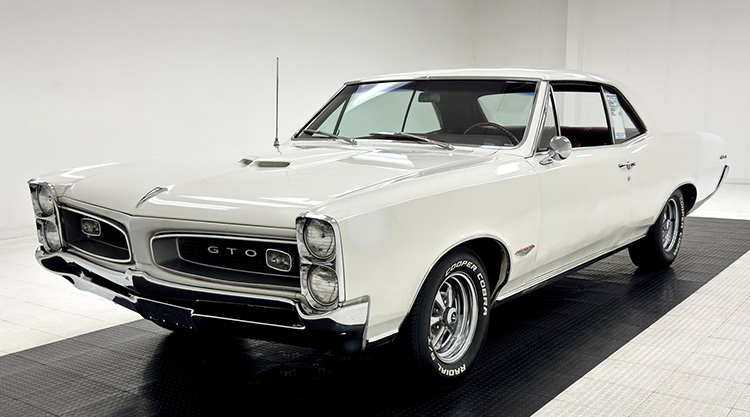
One Saturday, a magnificent white sports car—a Pontiac GTO—pulled up in front of our quarters. We clustered at the door to gawk at the glamorous vehicle.
. . . . . . . . . . . . .
1966 Pontiac GTO hardtop with a V8 engine and “four on the floor.”
. . . . . . . . . . . . .
To our amazement, Sergeant Ruiz emerged from the driver’s seat and went behind the barracks, returning a few minutes later with a pail and water. He set to work washing his car.
“How the fuck did that creep get a car like that?” someone inquired.
“He probably stole it,” proposed another of my fellow recruits. Everyone laughed—sotto voce, of course. We didn’t want Sergeant Ruiz to hear us.
After watching a bit longer, someone noted rather plaintively, “A car like that can get you any girl you want.”
“You think Ruiz has got a chick?”
“What chick would have him?” asked Taylor, our resident wise guy. He thrust out his chest and put on a thick Puerto Rican accent: “Hey, mami, wash the floors, make the bed…suck my cock.”
We roared with laughter and headed back inside. I doubt Ruiz heard us. He was totally entranced by his car.
One Saturday, while most of the unit went downtown in search of booze and sex, I stayed behind to write to the composer Luciano Berio. All during basic training, he and I had been corresponding about our production, which was set to open the following January. It was a godsend to stay in touch with him and the world I cherished—the world of art, beauty, and creativity.
When I finished my letter, I went outside to post it—and there was Sergeant Ruiz, polishing his white GTO. Impressed by his devotion to the vehicle—a true automotive marvel—I walked over and said, “That’s some car you’ve got there.”
Clearly pleased, the terror of Charlie Company looked up and wiped the sweat off his forehead.
“I get it from the lot last week. It drive fantastic.” He stood back to admire it, his buff body glinting in the searing sun.
“I treat it just like my baby. Many years I soldier hard, work off my ass, and now.…”
He patted the hood with his big brown hand.
“I living the dream, man, living the fucking dream.”
A few Sundays later, our basic training nearly over, we were lazing on our bunks when Sergeant Ruiz thundered in, his face contorted with fury.
“Outside, fuckers! Now!” We raced outside and stood at attention in the sizzling sun.
“Look, look!” he yelled. He pointed to his GTO, parked at the curb beside him. Neatly piled up on its sleek white hood was a mound of red Georgia dirt.
“This ruin my car,” he cried. “This scratch the paint. The shop gotta do the hood again. You know how much that cost?”
Silence. Ruiz began stomping through our ranks. “Who did it? Which one you guys do it? I know it one you guys. Who? Who? Step up and be a man!”
Nobody budged.
“I could fucking report all of you!” he screamed. We’d been in the Army long enough to know he couldn’t. It was a Sunday; he was off duty, and so were we. If he went to the MPs, they’d say it was just a prank and tell him to get lost.
Faced with our silence, Ruiz was flummoxed. He seemed on the verge of tears.
That’s when I began to feel sorry for him. Sure, he could be a dick. Sure, he had a vicious tongue. But he’d never done anything really wrong, never struck anyone or used a racial slur. His harassment came out of the drill sergeant’s handbook: Rile up the troops so they bond and form a unit. We formed a unit, all right—a unit that detested him.
Only now, six decades later, do I realize what was really going on: racism. Just who does that brown guy think he is?
At the time, I didn’t see it that way. The guys in Charlie Company—mostly high school–educated, working-class whites, mainly from New England—were in their early 20s. (At 26, I was the oldest trainee in the company.) My fellow troopers were funny and frisky, like little puppies. I genuinely liked them.
In retrospect, I like them less.
This happened in the 1960s, at the dawn of the civil-rights era. Even though President Truman had desegregated the armed services in 1948, it still was highly unusual for a Latino to be promoted to drill sergeant. Ruiz was one of the fortunate few.
He didn’t feel fortunate at the time, of course. Muttering darkly to himself, he dismissed us, started up his car, revved his engine, and drove away.
Back in the barracks, it was deathly quiet. No one laughed or confessed or complained or asked probing questions. We acted as if nothing had happened. And kept up the game till the end of basic training a few weeks later.
Ian Strasfogel is an author, opera director, and impresario who has staged more than 100 productions of opera and music theater in European and American opera houses and music festivals. His comic novel, Operaland, and his biography of his father, Ignace Strasfogel: The Rediscovery of a Musical Wunderkind, were both published in 2021.
Other articles by Ian Strasfogel

Fun and Games with Sergeant Ruiz
Composing Term Papers and Poems on a Royal Quiet Deluxe

A (Very Timely) Haydn Appreciation
Remembrances of a Smith Corona, a Royal Standard, and an IBM Selectric
Working with Avant-Garde Composer Luciano Berio, 1965–1968
The Life, Times, and Torments of My Smith Corona

Whither the Kennedy Center?
The “What’s Happening” Kid

Cognitive Decline After a High-Pressure Career
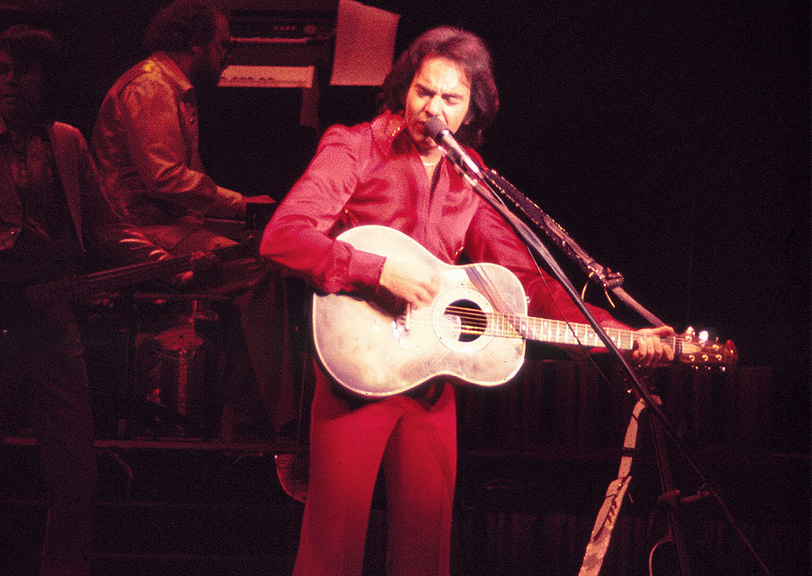
Neil Diamond Plays Fort Gordon!