
ENTER YOUR EMAIL TO RECEIVE OUR WEEKLY NEWSLETTER
Whither the Kennedy Center?
A look back at memorable and transcendent performances held in our nation’s premier performing-arts venue before its coming two-year closure leaves a cultural void in Washington, D.C.—and countrywide
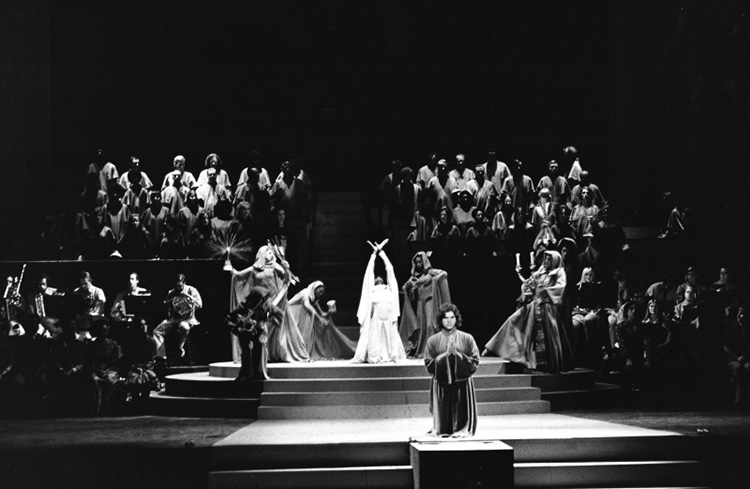
Opening night at the Kennedy Center: Alan Titus (the Celebrant) and members of the Alvin Ailey Dance Company performing in the original production of Leonard Bernstein’s Mass, 1971. Photo: Fletcher Drake, John F. Kennedy Center Archives.
. . . . . . . . . . . . .
April 20, 2026
Among the worrisome events of recent months, though in truth not the most grievous, was the executive usurpation of the Kennedy Center—the cultural jewel of the nation’s capital. For more than 40 years a showcase for the performing arts—for music, dance, and drama—the Kennedy Center has hosted a panoply of artistic excellence, some of it local, some from the American heartland, some from abroad.
Professionally managed and supported in part by a board of elected officials and farsighted philanthropists, the Center opened with a splash—the premiere of Leonard Bernstein’s Mass—and it never looked back. Now, claimed as presidential turf, with a sycophantic board and programming no longer the purview of performing-arts professionals, the Center faces a troubling future.
For those of us privileged to have attended the Kennedy Center at its opening and for years thereafter, the recent fiat that will shutter this institution for two years, for undisclosed repairs and renovations—though these projects always last longer, don’t they?—was devastating.
When I was a critic for The Washington Star, from 1970–1976, I covered primarily music, which meant reviewing concerts at that 3,700-seat behemoth, Constitution Hall, at George Washington University’s more modest Lisner Auditorium; and at The Phillips Collection, a splendid museum with top-tier art works and an intimate room for Sunday-afternoon recitals.
With its opening in 1971, the Kennedy Center fulfilled a dream that dated back to 1933, when First Lady Eleanor Roosevelt proposed building a venue that would provide work for unemployed actors during the Great Depression. Congressional hearings were held in 1935, in 1938, and throughout the 1950s. Finally, in 1958, Congress passed, and President Eisenhower signed, the National Cultural Center Act.
Progress was desultory, but tragedy spurred momentum. After the assassination of John F. Kennedy in 1963, the Center was reimagined as “a living memorial” to the slain president, and The National Cultural Center became the John F. Kennedy Center for the Performing Arts.
The Kennedy Center instantly transformed the capital. Local organizations now had state-of-the-art new homes; the National Symphony and the Washington Opera were prime tenants in the Concert Hall and Opera House, respectively. Of equal significance, the Center provided a proper venue for visiting ensembles—orchestras and dance companies from the United States and abroad—and for visitors.
Attendance soared. Culturally, Washington, D.C. had come of age overnight.
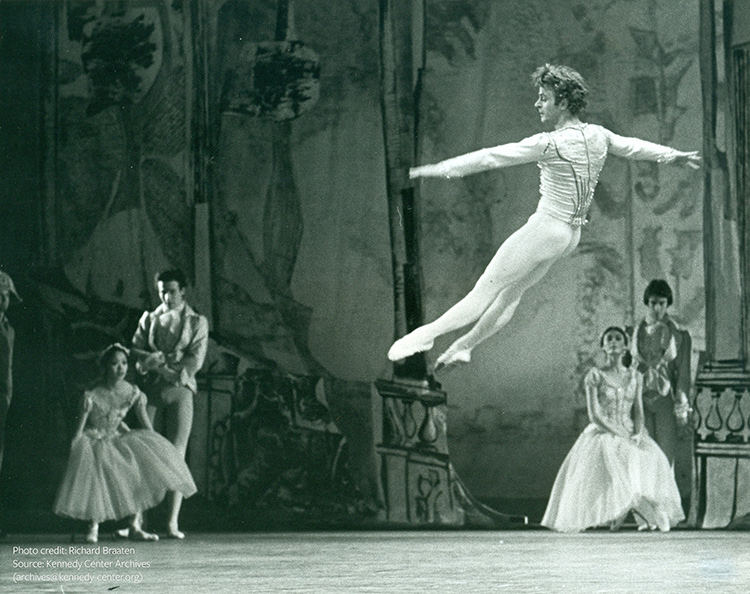
Aloft: The world premiere of Mikhail Baryshnikov’s Nutcracker for the American Ballet Theatre, featuring Marianna Tcherkassky as Clara, Alexander Minz as Drosselmeyer, and Baryshnikov himself as the Nutcracker Prince. Photo: Richard Braaten, John F. Kennedy Center Archives.
. . . . . . . . . . . . .
One day at The Washington Star, Newbold Noyes, whose family was then part-owner of that newspaper, and who served as its editor, approached me and asked, as a favor, if I would review a dance attraction at the newly opened Kennedy Center. Fortuitously, having followed the New York City Ballet since its early days (when it performed at Manhattan’s City Center before moving to Lincoln Center), I had seen more dance than my journalist colleagues.
Newby wasn’t sure of the details of that event, but his aunt Lucia was somehow involved. Lucia, as it happened, was Lucia Chase, one of the founders of the American Ballet Theatre (ABT). With Richard Pleasant, a seasoned arts administrator who had a penchant for dance, Aunt Lucia created a powerhouse. Founded in 1939, in 2006 ABT was recognized by Congress as “America’s National Ballet Company.”
For its Kennedy Center debut, the ABT presented a program that included Romeo and Juliet—a transcendent masterpiece from 1943, by the British choreographer Antony Tudor, whose close association with the ABT had begun in 1940. Tragically, Tudor’s Romeo is now lost. The ballet was not notated, nor was it filmed or videoed, and none of the original dancers have sufficient recall to enable a restaging. I might have seen one of its last performances ever.
That Kennedy Center performance remains an indelible memory. Always impeccable in his choice of music, Tudor set his Romeo to scores by Frederick Delius that were gauzy, atmospheric, impressionistic. Near the ballet’s beginning, Juliet—Natalia Makarova—appeared, wafting to center stage. Her entrance was flawlessly calibrated to the flow of the music. (Few other choreographers shared Tudor’s innate understanding of music and its relationship to movement). Then she rose on half-point; that is, midway between standing flat on the stage and elevated to the tip of her toe shoe. Few movements could be simpler, yet 2,300 onlookers gasped as one, knocked out by a gesture of pure poetic essence.
And here’s another vignette, still vivid. When ABT presented At Midnight, choreographed by Eliot Feld, the lead dancer was Daniel Levins. At one point, as Levins traced circles with one arm in the air before him, his movements were so obsessive that you thought he’d never stop. But then, suddenly, with his arm at its apogee, he abruptly shifted gears and let his now-limp hand rise, as if it were weightless and pulled like a puppet by a string. Again, the audience sat stunned as if by magic.
But there was levity, too. One of the funniest moments I’ve ever observed occurred in the Kennedy Center Opera House before a performance by the Washington Opera of a Mozart opera—was it Così Fan Tutte? When the doors opened to admit the audience, I took my seat and found I was directly behind Martin Feinstein, then the opera company’s general manager. Martin was a protégé of the legendary impresario Sol Hurok, and like his mentor, he was smart, tough, and funny. Before the overture began, as audience members found their seats, they saw a character out of commedia dell’arte, a Pulcinella, sitting solo on a stool in front of the curtain, one leg crossed over the other, staring out at the audience. Martin’s wife, perplexed, asked him what the creature was doing, and without missing a beat, Martin, ever the impresario, responded, “Counting the house”. (Perhaps you had to have been there.)
Shuttering the Center might be applauded by some, bemoaned by others. From my seat on the aisle, it is nothing short of disastrous.
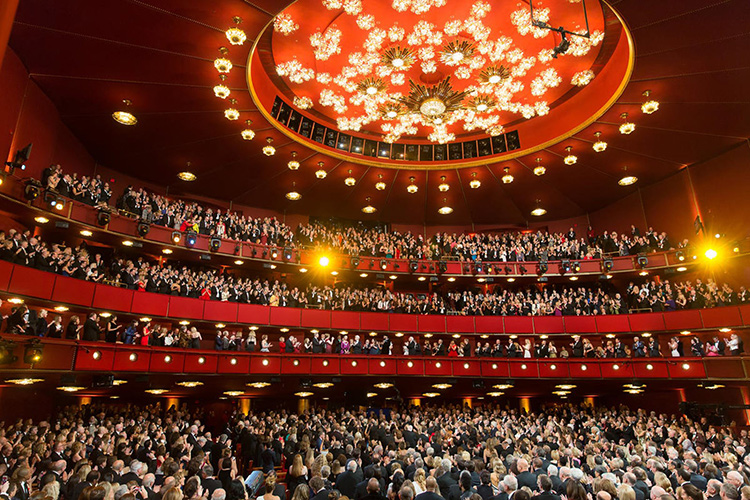
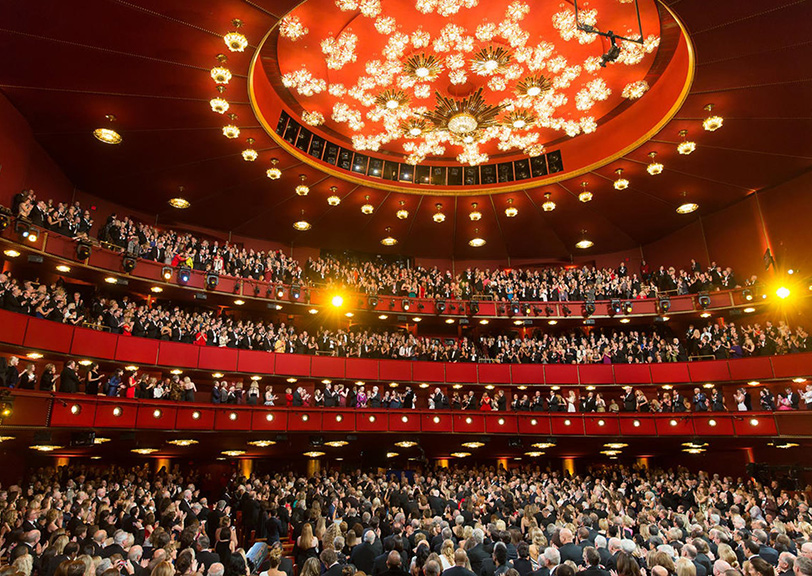
A premier venue: The Kennedy Center’s red and gold Opera House, topped by a crystal chandelier. Photo: John F. Kennedy Center
. . . . . . . . . . . . .
Protesting the politicization of the Center, many elite performers and ensembles already have canceled upcoming appearances. They include the Alvin Ailey American Dance Theater, the Seattle Children’s Theater, the Martha Graham Dance Company, the virtuoso banjo player Bela Fleck, Hamilton: An American Musical, duo pianists Maria João Pires and Marc-André Hamelin, and future seasons of the Washington Opera and Washington Performing Arts—for 60 years the District of Columbia’s preeminent presenter of cultural smorgasbord.
I’d wager more artists will follow. And not only artists. Most recently, Richard Grenell, the Center’s czar, quit his position, with no comment, after a one-year tenure. A political operative for Republican causes and a presidential loyalist, he will be replaced by Matt Floca, whose career has thus far been in construction management.
One withdrawal that received considerable notice was the cancellation of the premiere of Symphony No. 15 by Philip Glass—arguably our most consequential and prodigious composer. His music is everywhere—in the opera houses, at the ballet, in films, and in concert halls, where his symphonies trace a unique artistic trajectory and reveal flights of uncommon fancy. I’m thinking of his Symphonies Nos. 1, 4, and 12, which riff on David Bowie’s “Berlin Trilogy” albums—Low, Heroes, and Lodger. The music deepens your appreciation of both Bowie and Glass.
Commissioned by the National Symphony six years ago and scheduled to be premiered this coming June in the Kennedy Center Concert Hall, Symphony No. 15 recently was canceled by the composer. In a letter to the Kennedy Center, Glass wrote that the symphony “is a portrait of Abraham Lincoln, and the values of the Kennedy Center today are in direct conflict with the message of the symphony.”
Indeed. Symphony No. 15 honors and reminds us of President Lincoln’s Lyceum Speech, delivered in 1838 to the Young Men’s Lyceum, a debating society in Springfield, Illinois. Its import, as described by the National Constitution Center, is germane. For Lincoln, a recently changed political landscape represented “a dangerous moment for America—a time when ambitious politicians might be tempted to operate outside of the boundaries of the law to secure their own moment of glory.” Furthermore, Lincoln feared that the rise of mob violence might threaten the survival of republican government itself. His Lyceum Speech remains a stark rebuke to the dangers of mob violence and an enduring defense of the rule of law.
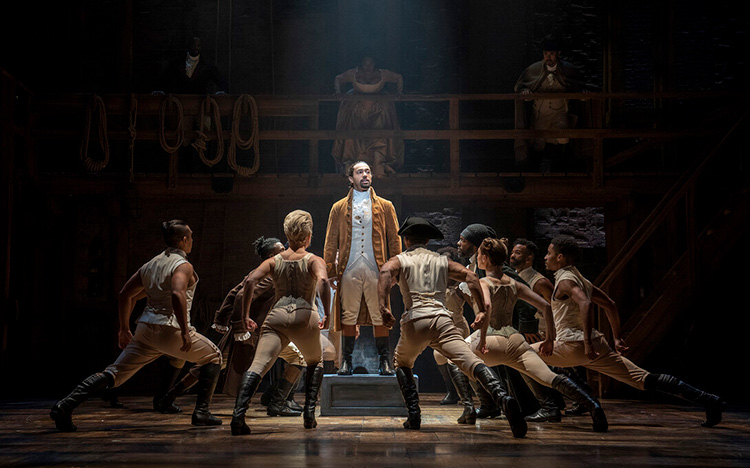
A founding father holds forth: Or he would have held forth—had Hamilton, one of two dozen Kennedy Center performances, not been canceled, postponed, or moved, following leadership changes.
. . . . . . . . . . . . .
While it might help revive the art of ormolu, closing the Center—the Kennedy Center—will wantonly erase more than four decades of cultural history. In the District, a collective appreciation of and participation in the performing arts will be lost; loyal audiences are hard to cultivate, and once gone, they are hard to win back.
Take, for example, live theater. In a recent post appearing in American Theatre, an online publication from the estimable Theatre Communications Group, we read what happened when the performing arts were last jolted—by the COVID epidemic: “Data provided to SMU DataArts by more than 100 theaters (SMU DataArts is a national center for arts research) show [that] most theaters are still working to regain the ground lost during the pandemic; 34 percent fewer audience members have returned…(along with 44 percent fewer subscribers). So reliance on existing customers as the primary earned revenue engine of future growth is a precarious strategy that would seek to glean more money from fewer attendees.”
The precipitous drop in subscribers, along with a loss of their contributions, is devastating for live theater and must be worrisome for the allied arts.
Additionally, hundreds of jobs will be lost by scores of skilled musicians, highly trained backstage personnel, and dozens of administrative support staffers. What’s more, we will be deprived of world-class performers from the United States, as well as abroad. (During my tenure, we enjoyed regular visits from the Royal Ballet in London and the Stuttgart Ballet, as well as from the New York City Ballet, the American Ballet Theatre, and many, many more such ensembles.)
If there’s an advantage to be gained by erasing the aspirations of our political and cultural leadership dating back to the 1930s, it is difficult to discern. The visionary New Deal has become our Raw Deal.
George Gelles was the dance critic of The Washington Star from 1970 to 1976 and the author of A Beautiful Time for Dancers. He thinks of himself basically as a musician—a horn player—who just happened not to play professionally for 37 years. Gelles has also written about music and dance for The New York Times, The New Grove Dictionary of Music and Musicians, and Musical America, and lectured on music and dance at the Smithsonian, George Washington University, and the San Francisco Conservatory of Music. And from 1986 to 2000, he was the executive director of San Francisco’s Philharmonia Baroque Orchestra.
You may enjoy other articles by George Gelles:
Michael Tilson Thomas: An Appreciation of the American Conductor

Composing Term Papers and Poems on a Royal Quiet Deluxe
A (Very Timely) Haydn Appreciation
Remembrances of a Smith Corona, a Royal Standard, and an IBM Selectric
Working with Avant-Garde Composer Luciano Berio, 1965–1968
The Life, Times, and Torments of My Smith Corona
Whither the Kennedy Center?
The “What’s Happening” Kid

Cognitive Decline After a High-Pressure Career
Neil Diamond Plays Fort Gordon!

Our 2026 Fundraising Request