
ENTER YOUR EMAIL TO RECEIVE OUR WEEKLY NEWSLETTER
A (Very Timely) Haydn Appreciation
Coming up: Haydn2032–celebrations of the 300th anniversary of a risk-taking Classical composer
By George Gelles
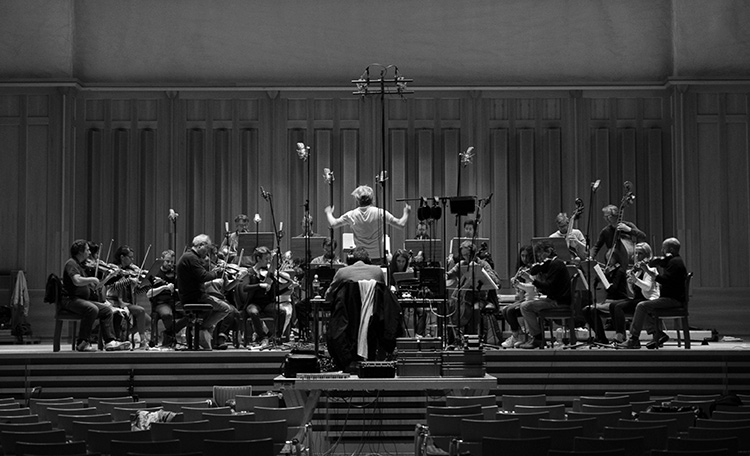
Strike up the Baroque band: An Il Giardino Armonico recording session in action.
. . . . . . . . . . . . .
August 13, 2026
Of our greatest composers, Haydn is the least performed and most misunderstood, underappreciated, and unjustly ignored.
Here at home, the New York Philharmonic next season will perform only one of his works, the Symphony No. 6, Le Matin (“Morning”). If your local orchestra programs one of his symphonies, it is likely to be a named work he wrote late in life, The Surprise, The Clock, and the Drum Roll among them.
Should you not as yet have made his acquaintance, Franz Joseph Haydn was born in 1732 into an Austrian family of modest means. His musical gifts were soon recognized, and in 1740 he was named choirboy at St. Stephen’s Cathedral, the heart of Vienna’s spiritual life. When his voice cracked—let’s say “matured”—and he was no longer a boy soprano, he was dismissed after nine years’ service.
An autodidact, he spent the next decade teaching himself the composer’s craft. Gaining a formidable reputation, Haydn soon was hired by the prosperous Esterhazy family. His new home was Schloss Esterhazy in countryside Eisenstadt, and his tenure lasted almost three decades, from 1761 to 1790.
Haydn’s output was prodigious and much praised. He was saddled with sobriquets including “The Father of the Symphony” and “The Father of the String Quartet,” genres in which he excelled; there is, however, no direct evidence that he sired either.
Though performances of Haydn have become regrettably rare, this might soon change thanks to the advocacy and example of Haydn2032.
Haydn2032 is a Swiss-based initiative, a nonprofit that aims to revisit, rethink, rehabilitate, and record all 107 Haydn symphonies in time for the 300th anniversary, in March 2032, of the composer’s birth. The idea was a dream of Christoph Mueller, an impresario’s impresario. Basel-born and -bred and conservatory-trained, the multifaceted Mueller also heads an artist management agency, serves as artistic director of the Yehudi Menuhin Festival in Gstaad, Switzerland, and manages the Basel Chamber Orchestra.
Choosing wisely, Mueller selected Giovanni Antonini to provide the musical leadership of his project. Maestro Antonini was an ideal choice. With Il Giardino Armonico (“The Garden of Harmony”), the crack period-instrument orchestra he’s conducted since its founding in 1985, he and his musicians have won wide recognition for recordings of Vivaldi and other Baroque masters.
Maestro Antonini led Il Giardino in a smooth stylistic transition from the Baroque to the classical repertory, and his Haydn performances are superb—deeply musical, with slow movements that breathe and fast ones that scamper. Actually, we get more than just performances. On YouTube you’ll see each of the symphonies in concert. Performance videos and sound are generally excellent, and watching them we become members of the audience. Better, in fact. From our privileged perch, we watch close-ups of conductor and musicians as they go about their business, something those in the auditorium will never see.
In anticipation of a surge of interest in Haydn as his tricentennial nears, let’s be among the first on the bandwagon and sample several remarkable works.
Symphonies 6, 7, 8 (Le Matin, Le Midi, Le Soir) (1761)
These were the first works composed for the Esterhazys at Eisenstadt. Each symphony depicts a time of day—“Morning,” “Midday,” and “Evening”—and they are examples of “characteristic” symphonies, works inspired by an extra-musical source. Le Matin opens with a sunrise, and Le Soir closes with a thunderstorm. (Does Beethoven’s Pastoral Symphony come to mind?) Generous in their solo writing for virtually every section of the orchestra, the works were meant to curry favor with his musicians and, in its skillful depictions, with his new patron.
Symphony 28 (1765)
The opening movement is dazzling and unique. Its tempo is 6/8; that is, two beats per measure with three eighth-notes in each beat. But then in a sleight of hand, Haydn changes the shape of the phrasing in an agitated few measures, and then, moments later, the piece continues in triple time, taking us on a wild ride from 6/8 to 3/4 before the movement is half over. Do you know which of his contemporaries engaged in such divine trickery? None of them; that’s who.
Symphony 31 (1765)
The “Hornsignal” celebrates the splendid and rare presence of four horns in the Esterhazy orchestra, where a pair was the customary complement. On occasion the group was enlarged, and when it was, Haydn composed with extra exuberance.
The last movement, a theme and variations, is exceptionally generous. Haydn gives solos, in successive variations, to his most prominent players, first to horns and oboes, then cello, then flute, the solo horn, the concertmaster, the wind band, the double bass. Haydn’s musicians must have loved him.
Symphony 44 (1772)
Ignore the nickname of the Trauer, or “Mourning Symphony”; it was based on a misunderstanding and means nothing. But pay close attention to this fine example of Haydn’s Sturm und Drang (“Storm and Stress”) period.
The style takes its name from a play by Frederich Klinger, and though the play wasn’t published until 1777, its stylistic characteristics—the expression of extremes, the use of minor keys, abrupt dynamic shifts, melodic angularity—were already affecting music by 1770.
There’s an emotional intensity here that we didn’t experience in earlier symphonies, and Haydn’s customary affability is replaced by a stern introspection, as you hear immediately in the work’s austere opening.
Symphony 47 (1772?)
(View it on YouTube.)
Nicknamed “The Palindrome,” this is at once one of Haydn’s most learned and most deeply pleasurable symphonies. In the slow movement’s theme and variations, Haydn shows his mastery of counterpoint, a basic compositional technique he taught himself from the Gradus ad Parnassum (“The Steps to Mount Parnassus”), the indispensable treatise on the topic by Johann Fux.
In the Minuet and Trio we hear why “The Palindrome” is so named. The second half of each movement echoes the first, note for note, backwards. Listening, you don’t think of artifice, but of art.
Symphony 65 (1772)
With his Symphony No. 65, Haydn ventured into imaginative realms that today are still as striking as they must have been to his first audience. Composed circa 1772 and ’73, the work is classified as Sturm und Drang, but rather than the violent aspects of that mid- to late-18th century literary and musical movement, Haydn here composed music that is edgy and unanticipated—in defiance of conventional musical logic.
In his foundational five-volume study of the composer, the Haydn scholar H. Robbins Landon suggests that the piece was composed as incidental music for a theatrical production. The Haydn expert Elaine Sisman narrows the focus, suggesting the play was Hamlet. In her essential essay “Haydn, Shakespeare, and the Rules of Originality” (found in the Haydn and His World anthology), Sisman cites the slow movement, where the lyrical flow of the strings is interrupted, indeed disjointed, by unrelated fanfare-like interjections from the winds.
More radical still is this symphony’s Minuet and Trio. The late musicologist H.C. Robbins Landon called Symphony 65 “a piece of almost lunatic irrationality,” and I’d wager that what seems like aimless meandering in the Trio is as audacious as anything Haydn ever wrote.
Symphony 75 (c. 1780)
Lost among more celebrated Haydn symphonies is this forward-looking, rarely heard treasure. Mozart copied the opening themes for himself from this and two related works, “undoubtedly with an eye,” Charles Rosen suggests (in The Classical Style), “to conducting them at his concerts.”
Rosen offers unstinting praise: The work “attains grandeur at once in the slow, grave introduction…the musical line is everywhere deeply expressive and unforced.…
“The slow movement must have been exceptionally interesting to Mozart, as the soft hymn-like theme, a type of melody that Haydn appears to have been the first to write, is a model for much of the music that Mozart was later to develop.…”
——
Performances of the 107 symphonies are shared by Il Giardino Armonico and the Basel Chamber Orchestra, and public concerts are offered twice yearly, in autumn and spring. Each ensemble approximates the size known to Haydn: usually 13 strings, oboes and horns in pairs, a single bassoon, occasionally a flute, rarely trumpets and kettledrums.
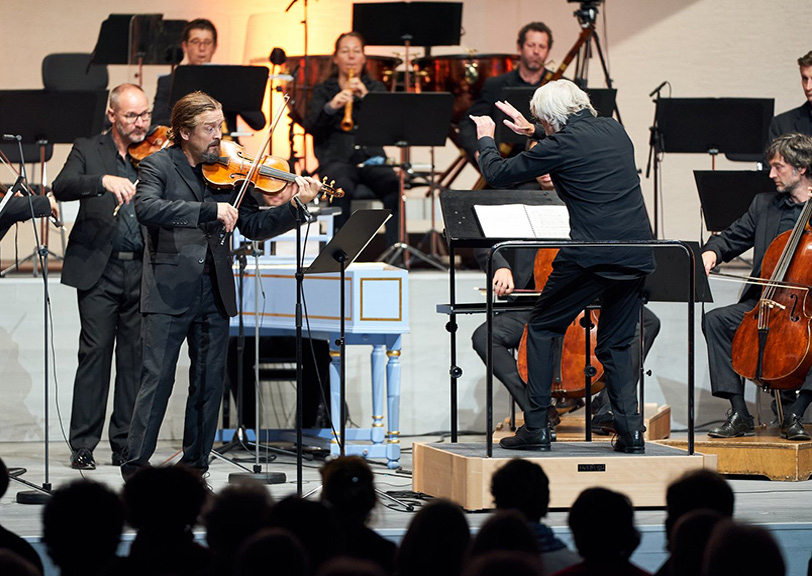
To both ensembles Maestro Antonini brings equal vigor and high intelligence. On the podium, he’s Haydn’s most passionate advocate, his physicality put to good use inspiring his musicians to give their excellent best.
The video of Symphony 47 is perhaps the most intimate and instructive of the few that we’ve sampled. The camera is obsessed with Maestro Antonini’s facial expressions and gestures, and his movements are never merely for show. Each evokes a musical response from his players.
Two musicians get special mention. Stefano Barneschi, concertmaster of Il Giardino, is a rock as leader of the string section. During Symphony 47, notice his frequent eye contact with Maestro Antonini; they’re sharing real-time information about the performance’s trajectory, and this information is modeled by Barneschi for the ensemble’s other members.
And then there’s Johannes Hinterholzer, the principal hornist, whose jaw-dropping artistry dispatches the impossible with flawless accuracy and poise. Barneschi and Hinterholzer are seen in most performance, though not all.
As if the videos’ performances weren’t enough, Haydn2032 is collaborating on this project with Magnum, the photo agency established in 1947. Members of the collective elevated photojournalism to art. Alpha Classics, the Paris-based independent label, is issuing these Haydn symphonies on both LP and CD, and the cover of each release boasts the work of a Magnum photographer.
Though this whimsical LP/CD cover doesn’t reveal its repertory—many of the covers don’t—it likely alludes to Haydn’s Symphony 83, nicknamed ‘La Poule’ (The Hen), for the farmyard pecking of the oboes in the opening movement’s second theme. Playing chicken, indeed.
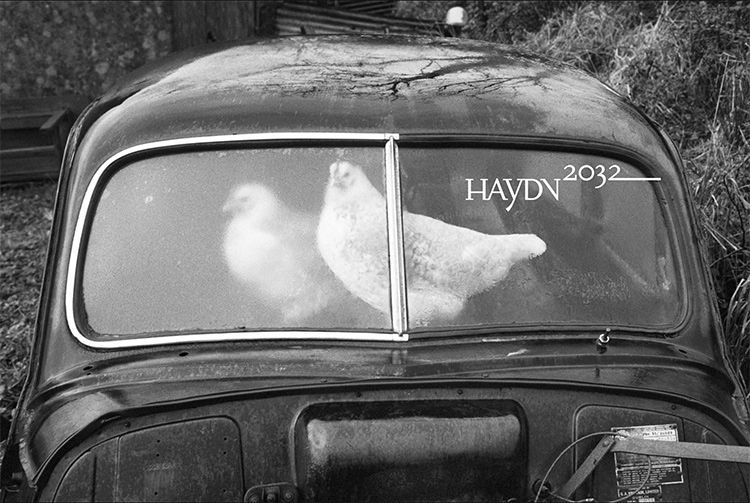
Birds of a fine feather: referencing the sounds of clucking and pecking chickens in Haydn’s Symphony No. 83, a.k.a. “The Hen”. Magnum Photos photographer, Martin Parr.
. . . . . . . . . . . . .
Let’s leave a summation to perhaps the most eminent Haydn scholar, H.C. Robbins Landon:
“Haydn…achieved total European popularity within his lifetime; by 1790 his music was adored even in the far corners of the Continent….
“Such popularity and, it must be added, profound respect do not happen accidentally.…
“It was…the result of a deep-seated conviction of supra-national dimensions, on the part of the public, that Haydn’s language was their language; it was a case of total, or near-total, identification of the audience with the composer, on a European scale. Perhaps it has never happened again to that extent during a composer’s lifetime.”
Modest, genuine, and generous throughout his life, Haydn let his music reveal who he was.
Toward the end, he proposed his own, most fitting epitaph:
Vixi, scripsi, dixi: “I lived, I wrote, I spoke.”
George Gelles was the dance critic of The Washington Star from 1970 to 1976 and the author of A Beautiful Time for Dancers. He thinks of himself basically as a musician—a horn player—who just happened not to play professionally for 37 years. Gelles has also written about music and dance for The New York Times, The New Grove Dictionary of Music and Musicians, and Musical America, and lectured on music and dance at the Smithsonian, George Washington University, and the San Francisco Conservatory of Music. And from 1986 to 2000, he was the executive director of San Francisco’s Philharmonia Baroque Orchestra.
You may enjoy other articles by George Gelles:
Michael Tilson Thomas: An Appreciation of the American Conductor

A (Very Timely) Haydn Appreciation
Remembrances of a Smith Corona, a Royal Standard, and an IBM Selectric
Working with Avant-Garde Composer Luciano Berio, 1965–1968
The Life, Times, and Torments of My Smith Corona
Whither the Kennedy Center?
The “What’s Happening” Kid

Cognitive Decline After a High-Pressure Career
Neil Diamond Plays Fort Gordon!
Our 2026 Fundraising Request
My Vietnam War—Part 1 in a Series