
ENTER YOUR EMAIL TO RECEIVE OUR WEEKLY NEWSLETTER
Working with Avant-Garde Composer Luciano Berio, 1965–1968
How the Italian composer’s “fierce, idiosyncratic masterwork,” Passaggio, got staged in New York during the Vietnam War
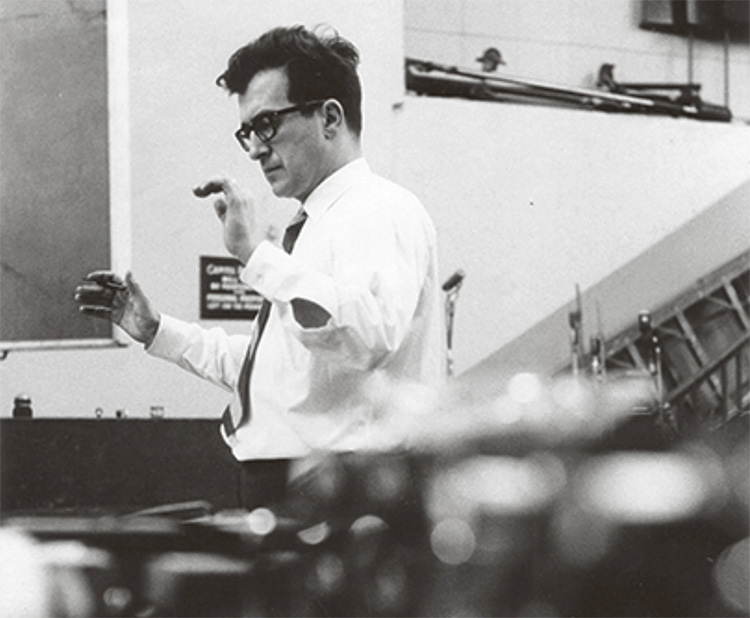
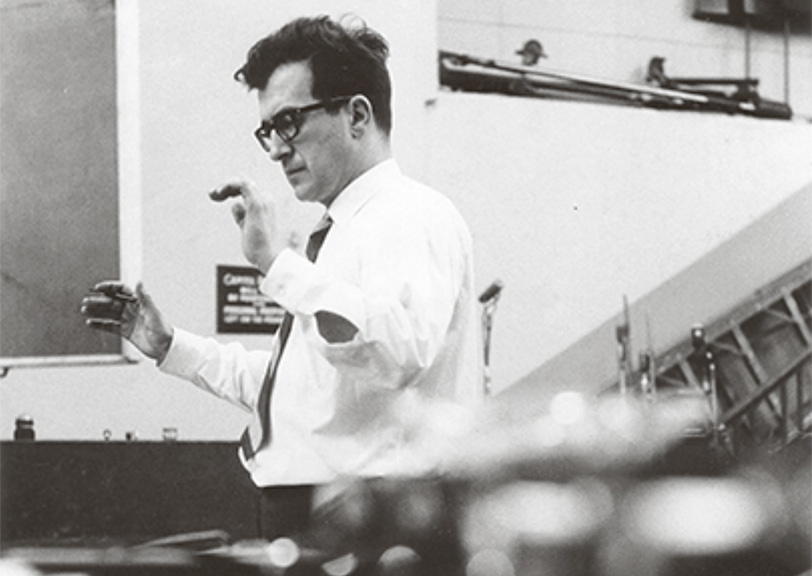
On the job: the avant-garde composer Luciano Berio.
. . . . . . . . . . . . .
My Vietnam War, 1966–1968 Article No. 4 in a series
. . . . . . . . . . . . .
June 24, 2026
Luciano Berio and I met and worked together during the 1960s—at the height of the Vietnam War. Like most artists of the time, we were totally opposed to the United States’ involvement in that conflict on the other side of the world. Ironically, our project—the American premiere of Berio’s stunning melodrama, Passaggio—came to fruition only because the U.S. Army permitted it.
It was in the fall of 1965 that Berio and I met. I was an assistant in the Opera Studies department at that world-renowned music conservatory, Juilliard, and—fortuitously—had yet to be tapped by my local draft board. (Back then—a time of mass conscription—I was among the lucky outliers.) Also fortuitously, The New York Times had just announced that Berio would soon join that school’s composition department, and I resolved on the spot to meet him. Why? I’m not certain. Until I saw that notice in the Times, I’d never heard a note of his music, never even known his name. But I hungered for something new.
That was when the opera world’s addiction to the past was wearying me. Masterworks of Verdi and Wagner, Mozart and Puccini dominated the repertory, with little or nothing from the 20th century—our century. True, the New York City Opera occasionally presented recent works. But they sounded pale and timid, like the lesser efforts of Sir Arthur Sullivan, of Gilbert & Sullivan fame. Raised in a household that cherished Stravinsky, Bartók, and Berg, I longed for operas that were fresh, fearless, and truly new.
I didn’t know it at the time, but Berio, the man I was shadowing through the halls of Juilliard, had written exactly that sort of piece: Passaggio, which had had its tumultuous opening in 1963 at the Piccolo Scala in Milan. Two years later, he would invite me to stage its American premiere.
But first—I had to meet him. Which wasn’t all that difficult. More or less everyone at Juilliard seemed to be friends with Berio. Brilliant young musicians, like the conductor Dennis Russell Davies and the composer Carmen Moore, flocked to Berio’s side as he strolled down the corridors, expounding amiably (and controversially) about the future of music.
One fall day in 1965, I barged into Luciano’s crowd in a Juilliard hallway, introduced myself, and in no time at all became a part of his surprisingly roomy inner circle. Knowing I was a director, he turned to me for tips about the Off-Off Broadway scene, which in those days brimmed with daring. We bonded as I described the thrilling shows—such as The Serpent and Paradise Now—that I’d seen performed by avant-garde groups like the Open Theater and Living Theater. I soon took him downtown to experience firsthand their sexually free, left-leaning work. These shows delighted him. He was totally open to the wildest flights of theatrical fancy.
Luciano was less open to the traditionalism of the Metropolitan Opera. In fact, when Rudolf Bing, the Met’s general manager, addressed an assembly at Juilliard, Luciano publicly accused him, not without reason, of being platitudinous and aesthetically retrograde. So bold was his attack that The New York Times covered it.
The approach Luciano took to his music came from a highly individual vantage point that both startled and stimulated me. Soon he and I got together frequently, our meetings morphing into lengthy lunches and dinners. I was in my mid-twenties at the time and rather naïve. I took his engagement with me at face value: We were simply friends, hanging out together.
In fact, Luciano was sizing me up.
One afternoon, he invited me to his little office at Juilliard—which in those days was on Claremont Avenue, near Columbia University—to hear some of his compositions. He played an LP featuring two of his sequenzas—his now-classic solos for flute and harp. They hit me like a thunderbolt. Their jagged dips and swerves struck me as a sort of musical Cubism—an assemblage of vibrant, challenging sound patterns. By the time these brief works ended, I decided that my newfound friend was a master.
My obvious admiration drew us closer. As winter settled in, Luciano started asking me curious questions—about the composer Peter Mennin, who’d served as Juilliard’s president from 1962 to 1983, and the nitty-gritty of Juilliard’s politics; about the abilities of various singers at the school’s Opera Studies program; about the acoustics of Harvard’s Loeb Drama Center, where I’d done student productions; about Harvard’s recently opened Carpenter Center for the Visual Arts, and its graduate design program; and about Monteverdi’s rarely performed Il Combattimento di Tancredi e Clorinda. To his astonishment, I’d staged that little masterwork in a crumbling castle in Umbria during my European travels a few years earlier.
It took a month or two before the purpose of my new friend’s questions became evident. Berio had been hatching plans with a fellow Italian, Professor Nino Pirrotta—the head of Harvard’s Music Department. They intended to present, in collaboration with Juilliard and the Rockefeller Foundation, the American premiere of Berio’s Passaggio on a double bill with Monteverdi’s Combattimento, in Berio’s new performance edition, at both Juilliard and Harvard. Would I like to direct it?
Would I?
Working with Berio was a breeze. Seeking novelty, he bubbled over with ideas and theories. A practical man of the theater, I fought for clarity, concision, and effectiveness. During our work scenes, I started calling Berio “Lucio”–a nickname I suspect he disliked but tolerated because we’d grown close while creating our show.
One evening, after a long, lively meeting in Berio’s cluttered apartment on Potter Place in Weehawken, New Jersey, we went out for a stroll. The weather was clear and chilly; all of Manhattan lay before us, its million lights dancing across the dark Hudson River—and Berio leaned over and hissed into my ear, “The bitch.” It was then that I realized how ambitious he was for our project. He wanted to conquer New York—and Boston, as well, while he was at it.
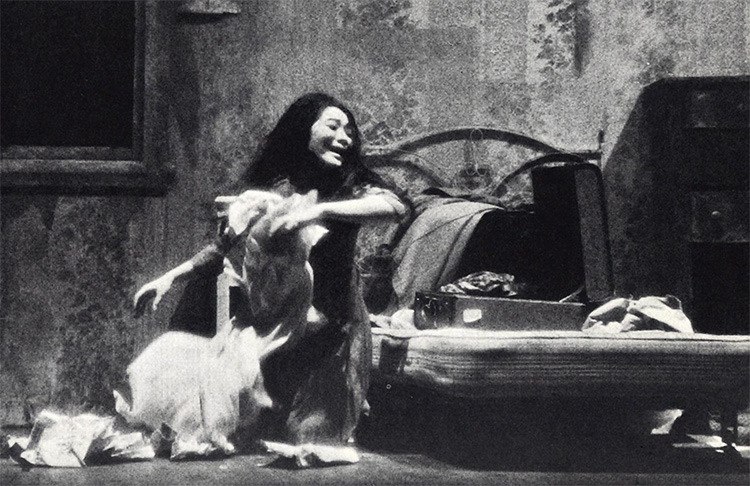
On a tear: The soprano Evelyn Mandac has had it in Passaggio’s climactic scene.
. . . . . . . . . . . . .
I didn’t express them at the time, but I had misgivings. I knew all too well how stodgy local opera audiences could be. Passaggio had caused a major scandal at its premiere in Milan a few years earlier. Set to a scattershot, non-linear text by the poet Eduardo Sanguinetti, and labeled, not very helpfully, a messa in scena–i.e., a production–the work was (and is) extremely difficult to characterize. It’s clearly not an opera; it has no plot, no story, no cast of characters—only genius.
An unnamed protagonist, She (Lei in Italian)—an outcast, a displaced person of some sort—appears onstage, seeking refuge. The world is against her. Choruses scattered throughout the concert hall barrage her with rules and regulations, laws and requirements. She visits an interrogation chamber, a jail, a flophouse, but never finds support or resolution. Finally, in an act of desperate self-assertion, She turns on her tormentors and shouts, “Leave me! Everybody! Go away!”
The abrupt ending concludes a nearly 30-minute struggle between the aggressive, hostile choruses placed in the auditorium and the leading lady onstage. And then ordering the audience to leave may sound more like provocation than resolution, but that is at the core of what Passaggio is—a fierce, idiosyncratic masterwork.
At first I wanted to emphasize the work’s anti-capitalist elements and set it in a Pop Art fantasy world. Luciano insisted on simpler, almost skeletal scenery, which made the struggles of the protagonist—memorably played by the Filipina soprano Evelyn Mandac—extra compelling. The fact that our leading lady was Asian, at a time when signers of that ethnicity rarely appeared in opera, amplified the work’s plea for tolerance.
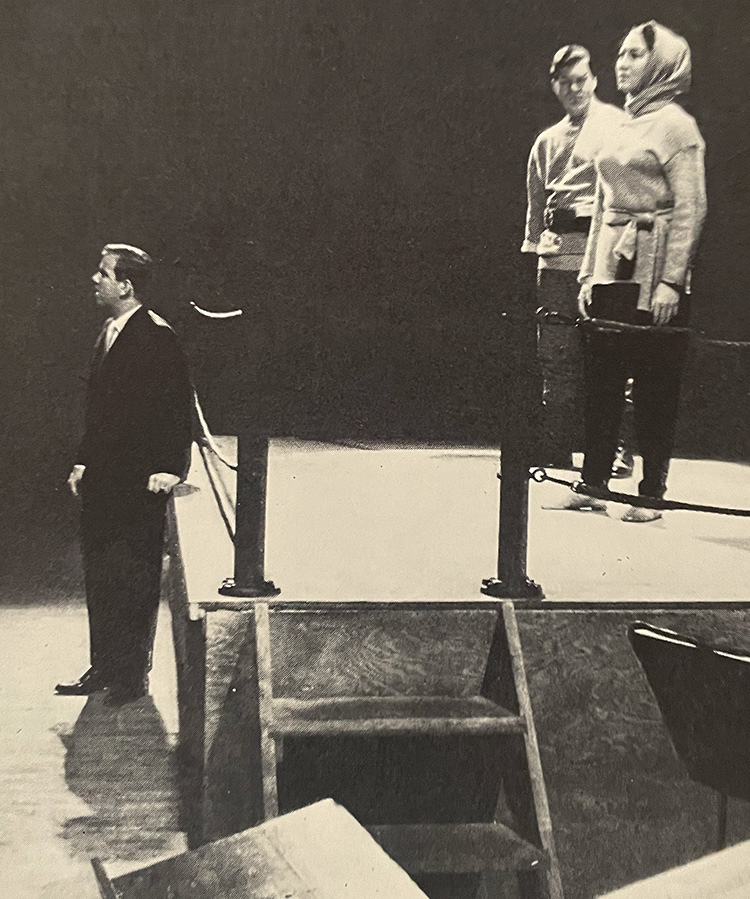
Monteverdi’s Il Combattimento as a wrestling match: Alan Titus and Evelyn Mandac are ready for action in the ring, while Robert Jones, the suited commentator, stands just outside the ropes.
. . . . . . . . . . . . .
Berio paired this work with Il Combattimento di Tancredi e Clorinda, Monteverdi’s word-for-word setting of a section of Gerusalemme Liberata (“Jerusalem Delivered”)—an epic poem by the Italian Renaissance poet Torquato Tasso. Like Passaggio, Monteverdi’s work straddles genres; it’s as much a sung narrative as it is an actual opera. A storyteller, the Testo, sings about the battle between Tancredi, a Crusader knight, and Clorinda, a Saracen warrior. The combatants mime their life-and-death struggle while the narrator and a tiny orchestra spell it out for us with uncanny effectiveness. After Tancredi mortally wounds his opponent, he removes her helmet and discovers that he has slaughtered the native woman he had fallen in love with. In other words, war destroys your humanity; you kill the person you love.
The work’s hatred of war made it startlingly relevant. To me, it wasn’t about the Crusades; it was about us, bogged down in the quagmire of Vietnam. I set it in a wrestling ring where a G.I. struggled with an Asian woman (Evelyn Mandac, again) while the narrator, dressed in a suit and tie, stood alongside the small orchestra and told the story. There were no supertitles back then, so Berio asked me to write an introduction that gave the details of the story. It read this way:
“Tonight, we shall present the battle between Tancredi and Clorinda,” it began. “A war story, set in a familiar time, the Crusades, when the East was ravaged by the West in the name of a cause more noble than war. The Christians march into the Holy Land. They slaughter, loot, and rape their way to the sacred gate of Jerusalem, where now they stand deadlocked with a determined foe, battling for his homeland.”
Today, with the benefit of 60 years’ hindsight, my well-intentioned text may seem timid. At the time, audiences understood what I was getting at. Berio certainly did. After reading the prologue, he looked up at me and grinned.
“Very nice! This gets you in trouble with the government,” he proposed.
A few days later, I was drafted.
My text had nothing to do with my induction, of course. Conscription was at its peak in 1966. More than 380,000 young men were put in uniform that year—fodder for our war in Vietnam. It hit me, a passionate “peacenik,” especially hard. I’d been nabbed at the very last moment, on the eve of my 26th birthday. Until then, I’d been staging shows all over the country, scampering up the operatic ladder. I hadn’t tried to evade service. I hadn’t claimed phony medical problems or gone to graduate school or married or fathered some kids to get an exemption. No, I lived as I wanted to live, and I placed my trust in luck.
My luck had finally run out.
When I told Berio, he gave me a wry look.
“Congratulations. You join the military-industrial complex.”
I tried my best to smile.
Ian Strasfogel is an author, opera director, and impresario who has staged more than 100 productions of opera and music theater in European and American opera houses and music festivals. His comic novel, Operaland, and his biography of his father, Ignace Strasfogel: The Rediscovery of a Musical Wunderkind, were both published in 2021.
Other articles by Ian Strasfogel

Remembrances of a Smith Corona, a Royal Standard, and an IBM Selectric
Working with Avant-Garde Composer Luciano Berio, 1965–1968
The Life, Times, and Torments of My Smith Corona
Whither the Kennedy Center?
The “What’s Happening” Kid

Cognitive Decline After a High-Pressure Career
Neil Diamond Plays Fort Gordon!

Our 2026 Fundraising Request
My Vietnam War—Part 1 in a Series
Creating a Life (and a Livelihood) in Italy