
ENTER YOUR EMAIL TO RECEIVE OUR WEEKLY NEWSLETTER
The “What’s Happening” Kid
Life in the Army with Frankie Lymon
. . . . . . . . . . . . .
My Vietnam War, 1966–1968, Article No. 3 in a series
. . . . . . . . . . . . .
March 4, 2026
One day, early in 1967, Major Pipkin proudly told me that Frankie Lymon had just been assigned to us in Special Services. Naturally, I had no idea who Frankie was.
“Strasfogel, that’s ridiculous,” the good major exclaimed. “Frankie’s hit ‘Why Do Fools Fall in Love’ topped the charts for weeks in the 1950s. And the kid was only thirteen. You must have heard it.” He hummed a few bars. They rang no bell whatsoever. “Come on, soldier, everyone knows it.”
“Except me, sir. Sorry…”
I’d just returned to the Army after a four-week leave in New York, where I staged the American premiere of Luciano Berio’s boldly experimental Passaggio. That jagged masterpiece is the absolute antithesis of American pop music.
Major Pipkin leaned back in his chair and stared at me. “What am I gonna do with you, Strasfogel? You’re from another planet.”
“Thank you,” I said and saluted. Major Pipkin laughed. “Sir,” I continued, “we just had that crazy episode with the phony Neil Diamond. Are we sure he’s the real deal?”
“He’s real, all right. I just got off the horn with his commanding officer. He’s finishing up basic and then he’s coming to us—to you, actually.”
“To me? What am I gonna do with him?” Our tiny unit, consisting of one civil servant, one staff sergeant, and low-man-on-the-totem-pole me, a Specialist 4, had very little to do. We put on a show once in a rare while, but that was about it. For the first time in my life, I felt deeply, pervasively bored. To break out of my torpor, I got the major to let me give some evening lectures (on opera, naturally) at the base library. A few soldiers dropped by from time to time, but my most loyal fans were housewives from neighboring Augusta, Georgia, who gobbled up the high culture I offered.
These women liked my lectures so much they started talking to their wealthy husbands, and swiftly, almost magically, a local movement grew to create a professional opera company in their tiny city, with me as artistic director. Since I was still very much in the military, I needed special permission to accept the engagement.
I know this sounds outlandish. How, in the midst of a major conflict, could a military base let a soldier run off to start an opera company? Fort Gordon did just that; it lent the expertise of Specialist 4 Strasfogel to the good citizens of Augusta. I’m still amused by the formal request for my services made by Ben Evans, the tireless local organizer in charge of the effort. In it, Ben makes the (perhaps hyperbolic) assertion that my participation was essential, since “we have been unable to find any civilian in the Southeastern United States who is qualified in this special field of training.” Ben’s request was promptly approved by the base commander, and the Augusta Opera was born. (Over time, the company became a well-respected part of the American operatic landscape, presenting excellent work for over four decades.)
I was busily preparing the company’s first offering, La Bohème, with singers from Juilliard and the Metropolitan Opera Studio, when Frankie Lymon reported for duty. Up to my ears in opera, I wondered what it would be like to work with a certified pop star.
On his first day, Frankie schlepped in like a bedraggled house pet. Enveloped, no, swamped by his rumpled uniform, he seemed unused to public scrutiny—shy, withdrawn, childlike. He was 24 at the time, but his short, slight stature made him seem much younger. Could this sweet, flimsy fellow really be the teenage pop sensation who whipped his female fans into a frenzy?
“Private Lymon, reporting for duty, sir.” Frankie’s salute had no snap to it, no authority.
“There’s no need to salute, Lymon; I’m just a lowly Spec 4. I’m no ‘sir,’ either. Call me Ian or Stras, whichever you prefer.” We shook hands. “The good news is no one’s hard core here. Our unit’s pretty much the exact opposite of basic training.”
“Cool.”
“But we’re still US Army. You gotta fix that uniform. Major Pipkin doesn’t like sloppy soldiers. The tailor shop on base can do it for you overnight.”
“Where’s the tailor shop?”
How could he not know? Everyone on base used it. “It’s right by the PX. Get it done tonight. I don’t want the major chewing you out tomorrow.”
“Right, gotcha.” He smiled a soft, sweet smile. “Thanks, Stras.”
He got his uniform tailored, but it never seemed to fit. In fact, everything about him felt unmilitary. Special Services offered a refuge for such types, but what would happen when Frankie collided with the real US Army?
Somehow or other, he avoided it. He stayed close to our unit, where things were light and easy. He’d stumble in late or screw up a task, but we rarely called him on it. He was so sweet, so effortlessly charming, he had us all eating out of his hand.
Over time, he and I developed an affectionate, lighthearted friendship. We were worlds apart, but I still felt drawn to him—not because he was a pop star, not because he’d “made it,” but because, deep down, he seemed so open to the world and yet so vulnerable. This aroused protective feelings: I didn’t want my buddy to get busted; I didn’t want him hurt.
Frankie was hurt, deeply wounded, though I didn’t know it at the time. All of us blithely assumed that Frankie had joined the Army to bolster his career, which had been in the doldrums since the early 1960s. We figured he’d enlisted to showcase his patriotism and find his way back to the limelight.
In fact, Frankie had been arrested on major drug charges in the summer of 1966. He’d been a heroin addict since his early teens, and the cops had caught him red-handed. As often happened in those days, when his case came to trial, the judge offered him a choice: Either face a substantial jail term and destroy his career, or enlist in the Army and make a fresh start.
Frankie truly did start over. I’m positive that he stayed clean the whole time he was at Fort Gordon. None of us ever witnessed any bizarre or disoriented behavior. He was mild and pleasant to everyone; we all enjoyed his company.
In our regular morning ritual, Frankie would arrive at the office, almost always late, and shout out, “Hey, Stras, what’s happening?” To which I’d invariably reply, “Not a whole helluva lot, Lymon.” And then we’d trudge off to our daily assignments.
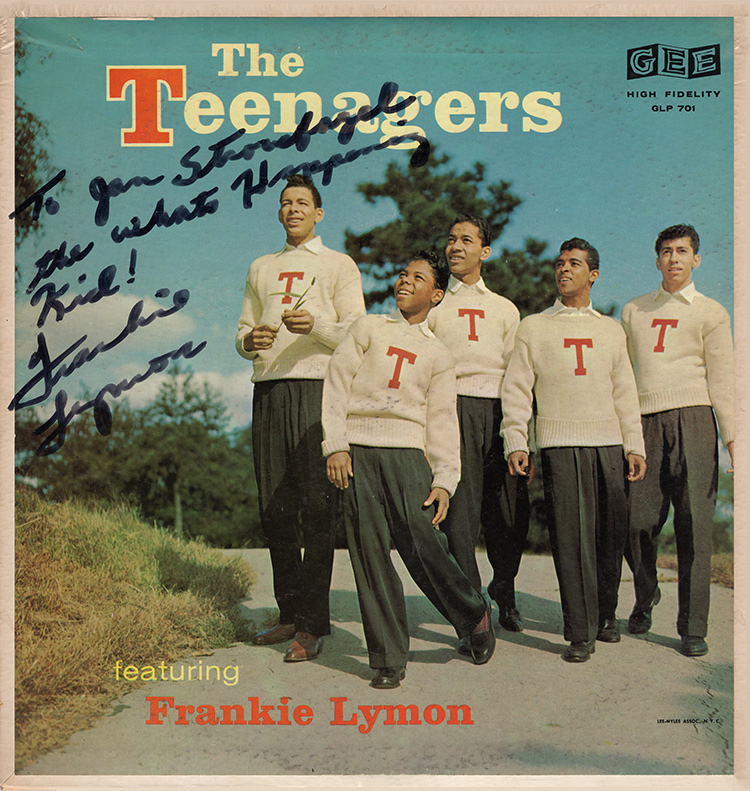
After we’d worked together for a few months, Frankie surprised me with an inscribed copy of his hit LP, Frankie Lymon and the Teenagers. On its cover, in his childlike scrawl, he wrote, “To Ian Strasfogel, the What’s Happening Kid.” I thanked him effusively, put it in the footlocker at the base of my bunk in Headquarters Company and forgot about it.
As Frankie continued working at Special Services, I grew increasingly irritated by his erratic job performance. On one occasion, just before a major inspection, I handed him a broom and asked him to sweep. When I looked back, he was standing exactly where I’d left him, staring at the broom as if it were some rare religious artifact.
“What’s going on, Frankie?” He looked at me sheepishly and shrugged. “Is there some problem?”
“Nah, piece of cake.” He squared his shoulders and set to work, whiffing the broom so lightly over the floor’s surface, the dirt stayed exactly where it was.
“Come on, put some muscle into it. I’ll hold the dust pan.” I crouched down to collect the dirt, but Frankie swept it right past me. “What the hell are you doing? Aim at the dust pan.”
He nodded and gave the broom another half-hearted push.
“Come on, you can do better than that!” Was he faking? Was he playing with me? Could he really not know how to use a broom? “Surely your parents made you sweep from time to time.”
“Not really.”
“How’s that possible?” He shrugged again. There was something forlorn about his incompetence. He seemed like a helpless little child. “I can’t believe your parents never asked you to clean up your room. What kind of people were they?” My question must have shocked him; the light drained from his face. I quickly changed the subject.
Over the succeeding weeks, Frankie improved his sweeping, but sweet as he was, respectful as he was, he never let me or anyone else get close to him. He’d smile and chatter, but remained a man apart.
During the spring of 1967, when the fall debut of the Augusta Opera was uppermost in my mind, I failed to notice that Frankie was showing up later and later, big bags under his eyes.
One day, it finally registered. Frankie stumbled in, clearly exhausted, his uniform a mess, and blurted out, “What’s happening, Stras?”
I exploded. “Man, what’s going on? You’re late all the time. I can’t keep covering for you.”
“But I’m in love! I met this fantastic schoolteacher.”
“So what,” I said tartly. “If Pipkin finds out, you’re toast.”
“But we’re getting married!” He’d gone downtown for casual sex from time to time, but this felt different. “And then I’m moving into her apartment,” he continued.
“Look, Frankie, you’re on duty here. The CO will go ballistic if you keep coming in so late.”
“Come on, Stras, gimme a break.” He flashed his sweet boy smile, which only increased my irritation.
“And another thing,” I said, “you owe us a concert, remember? Major Pipkin wants you to sing for the troops.”
“I told him already it can’t happen.”
“But it’s a natural. Everyone wants it.”
“I need my band. I need my backup singers. It won’t make sense without them.”
“Oh, come on, we can work around it. You’re the great Frankie Lymon.”
“So fucking what,” he said and stomped off. I didn’t see him for the rest of the day.
Now, decades later, I wonder if Frankie’s resistance stemmed from raw fear. The 13-year-old pop sensation was now a 25-year-old man. He had made all his great recordings as a boy soprano. What if the public didn’t want to hear an adult Frankie Lymon?
One glum morning in February 1968, I was waiting for him to appear when Major Pipkin summoned me to his office. He wasn’t in the best of spirits.
“Strasfogel, are you seriously asking for another leave?
“Yes, sir, I am. I’m sorry it’s on such short notice.” The New York City Opera had just offered me a major assignment—a revival of Puccini’s Il Trittico for its fall 1968 season.
“I don’t know how many times I let you off last year so you could do that opera downtown.” The major had a point. The Augusta Opera would never have existed without him.
“Sir, you’ve done a great deal for me, and I’m truly grateful. But I just got word about an urgent planning session for a big show they want me to do in a fancy new theater in Lincoln Center; it’s a really big deal.”
“Fort Gordon’s a big deal,” he said morosely.
“Of course, sir, I know. But I’m getting out soon, and this production could make my career.”
As he did so often, Major Pipkin leaned back and studied me with a mixture of mistrust and bewilderment. “You’re a strange duck, Strasfogel.”
“In a good way, I hope.”
“Maybe, maybe not.” His eyes narrowed. “The CO’s office keeps telling me how happy General Richardson is with you. How come he’s such a big fan?”
“Well, I addressed a meeting of officers’ wives a few months ago, and Mrs. Richardson was there. She really liked it.”
“You think it’s because of her?”
“Well, it could be,” I said, and left it at that. General Richardson’s crucial role in my posting to Special Services was a closely guarded secret. He and I never met in person, never had a private conversation. The few times I did see him I’d brace and salute like the other troops. He never acknowledged my presence, never once let on that he was the man who’d saved me from Vietnam.
“Sir, sorry; about my leave, will you approve it?”
Major Pipkin sighed and threw up his hands. “What do you think?”
“Thank you, sir,” I said and saluted. “Oh, by the way, Lymon hasn’t shown up the past few days. Is he on leave?”
“Didn’t you hear? He’s been discharged.”
“Discharged?” Swift, often shocking shifts were common in the Army. Orders suddenly came down, shipping off soldiers with no rhyme or reason. You’re here. You’re there. So what?
“Why so surprised?” said the major. “Lymon wasn’t military. He looked sloppy and came in late. He went AWOL so often the MPs wanted to give him a dishonorable discharge.”
“Oh, no.”
“I had to get on the horn to the Pentagon and convince them to change it to a general.” A general discharge was the Army’s way of saying that a soldier had served honorably, but with poor job performance—a pretty fair summary of Frankie’s soldiering.
“Do you know where he went?”
“Nah. Maybe he’s still in Augusta. Maybe he skipped off to New York. Who knows?”
Since I’d given up my own apartment when I got drafted, each time I went on leave I stayed in my parents’ small penthouse in midtown Manhattan. One morning shortly after my arrival—February 28, 1968, to be exact—I leafed through the morning’s Times. Buried in an inside page, I saw the headline: “Frankie Lymon Dies in Apartment Here.” Less an obituary than a cold police dispatch—another Black drug addict bites the dust—the piece barely mentioned my friend’s remarkable accomplishments as a major American singer/songwriter. Instead, its last sentence coldly noted that Frankie had recently written a magazine article about how he had “kicked the narcotics habit.” I found the comment gratuitous, a crude, racist snigger.
In my grief and sorrow, I remembered that I’d taken Frankie’s record home with me for safekeeping. I went to the living room, got out our phonograph, and placed it on a table next to a small, dour portrait of Johann Sebastian Bach, our family’s presiding deity.
I put on the record and finally heard the song that had made Frankie famous, the song everyone knew but me: “Why Do Fools Fall in Love.”
Frankie, the person, may have been elusive. Frankie, the musician, was clear. His joy and artistry resounded through the apartment. Johann Sebastian may have disapproved, but I found it absolutely wonderful.
Ian Strasfogel is an author, opera director, and impresario who has staged more than 100 productions of opera and music theater in European and American opera houses and music festivals. His comic novel, Operaland, and his biography of his father, Ignace Strasfogel: The Rediscovery of a Musical Wunderkind, were both published in 2021.

The “What’s Happening” Kid

Cognitive Decline After a High-Pressure Career
Neil Diamond Plays Fort Gordon!

Our 2026 Fundraising Request
My Vietnam War—Part 1 in a Series
Creating a Life (and a Livelihood) in Italy

The Paul Taylor Dance Company Returns to Lincoln Center

Reviewing the 63rd Annual New York Film Festival

These Days, It’s Women Who are Filing for Divorce

A Kerfuffle Over the Andarz Nama, an Ancient Persian Miniature